





Non-EU remote workers can live in Croatia for up to 18 months on its digital nomad temporary stay permit, provided they earn at least €3,622.50 a month from work done for employers or clients outside Croatia. You can apply online, and if your passport lets you enter Croatia visa-free, you can usually file from inside the country while you wait for a decision.
Below we walk through what the permit actually requires in late 2026, what it costs, and how to plan housing around the application. Figures come from the Croatian Ministry of the Interior (MUP) unless noted. Rules change, so always check the official page before you apply.
Who can apply for Croatia’s digital nomad permit?
The permit is open to third-country nationals, meaning anyone who is not an EU, EEA or Swiss citizen. If you hold an EU passport you don’t need it at all, because you already have the right to live in Croatia. For the rest, including British, American, Canadian and Australian remote workers, the key test is where your work comes from. According to MUP, you must work remotely using communication technology for a foreign employer or for your own company registered outside Croatia, and that company may not provide services to employers in Croatia.
In practice this means a salaried remote employee of a foreign company, or a self-employed founder whose company is registered and trading abroad, can qualify. Taking on Croatian clients while on the permit is not allowed.
How much income do I need to show?
The threshold is linked to Croatian wages: you must show at least 2.5 times the average monthly net salary paid in Croatia in the previous year. MUP currently lists this as €3,622.50 per month. You prove it with bank statements showing regular income or with payslips covering the last six months.
If your income is irregular, MUP also accepts a savings balance instead: €43,470 for a 12-month stay or €65,205 for 18 months. Bringing a partner or family member raises the requirement by 10% of one average monthly net salary per person. Because the number tracks Croatian wages, expect it to rise again when new salary statistics are published.
How long can I stay, and can I extend?
MUP grants the permit for a maximum of 18 months, and sometimes for less. If you receive a shorter permit, you can apply for an extension of up to six months, but you must file at least 60 days before your current stay expires. After the permit ends, you have to wait six months before submitting a new digital nomad application. Plan your exit, or your next destination, well in advance.
Once your permit is issued, your days in Croatia no longer count against the Schengen 90-in-180-day limit for short stays, according to analysis by Nomad Briefing.
How do I apply, online or at an embassy?
There are two routes. Visa-free nationals can apply online through MUP’s digital nomad portal or at a police administration if they are already legally in Croatia. Nationals who need a visa to enter Croatia must apply through a Croatian embassy or consulate; MUP warns that applications from visa-required nationals filed at a police station will be rejected.
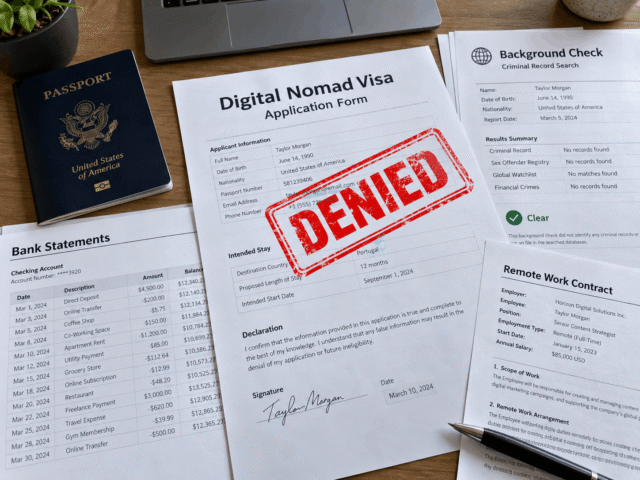
The core document list, per MUP, is:
- A passport valid for at least three months beyond your planned stay
- Health insurance covering Croatia for the whole stay
- Proof of remote work: an employment or service contract and employer statement, or your own company’s registration and proof of its activity
- Proof of income or savings, uploaded as PDFs of up to 2MB
- A legalised criminal record certificate from your home country, and from any country where you lived for more than a year beforehand
- An address in Croatia; for a first application, a hotel or hostel booking is accepted
Documents must be in Croatian or English, translations must be done by an authorised translator, and any funds must show their currency.
What does the permit cost?
MUP lists fees as separate line items. At a police administration you pay €46.45 for the temporary stay, a €9.29 administrative fee and €31.85 for the biometric residence card (€59.73 for accelerated issue), roughly €88 in total. At a diplomatic mission, the temporary stay fee is €55.74, plus €93 for a long-term D visa (and any VFS service charge) where one is needed. DigitalNomadVisa.com puts the typical processing time at around 30 days, though MUP itself does not publish a target.
Do I pay tax in Croatia on a digital nomad permit?
MUP’s permit page does not cover tax. However, Nomad Briefing notes that Croatia’s Income Tax Act exempts qualifying digital nomad income paid by an employer not registered in Croatia. That exemption only covers Croatian tax. Your home country may still tax you, and self-employed applicants should confirm their position with a Croatian tax adviser before relying on it.
What happens after I arrive?
Registration deadlines are where people slip up. MUP’s page says you must register your temporary address within three days of entering Croatia, and separately register your temporary residence within 30 days of your stay starting (or six months if you came on a D visa); missing that second deadline can see your stay revoked. Nomad Briefing reports that a 2026 amendment extended the first deadline to 15 days, while MUP’s page still shows three, so the safest approach is to register within three days anyway.
Where should I stay while applying?
Because you need a Croatian address, and because the first months are often spent waiting on paperwork, it makes sense to book a long-stay base with reliable internet from day one. Croatia currently has more bookable Stays on Nomad Stays than any other country, and every price includes water, power and fibre internet. Three that suit a permit-length stay this winter:
- Tisno Adriatic Remote Work Living – a two-bedroom apartment for up to four guests, about 50 metres from the sea in Tisno, between Zadar and Split airports. It has a dedicated workspace with a 4K external monitor, and its connection measured 501 Mbps download in September 2026. From €455 per week.
- Nest Work Retreat, Pula – a bright 47 m² one-bedroom apartment in a quiet part of Pula with a desk, 4K monitor, balcony and private covered parking. Coworking Pula is a 15–20 minute walk away, and the airport is about 8 km away. Its winter long-stay package runs to March 2027, from €398 per week.
- Bibinje Apartments, near Zadar – a ground-floor two-bedroom apartment on the seafront in Bibinje, with Starlink internet, a terrace, rooftop pool and free parking, about 10 minutes from Zadar.
All three showed open dates for a 30-night stay starting this week when we checked. Want to compare Croatia’s permit against other countries? See Croatia on DigitalNomadVisa.com.
Frequently asked questions
Is Croatia’s digital nomad permit a visa?
Not exactly. It is a temporary stay (residence) permit. Visa-required nationals also need a long-term D visa to enter.
Can EU citizens use the Croatia digital nomad permit?
No, and they don’t need to. EU, EEA and Swiss citizens can already live and work in Croatia under free movement rules.
What is the Croatia digital nomad income requirement in 2026?
MUP lists €3,622.50 per month, or savings of €43,470 for 12 months or €65,205 for 18 months, plus 10% of an average net salary per extra family member.
Can I work for Croatian clients on the permit?
No. Your employer or company must be registered outside Croatia and must not provide services to employers in Croatia.
Can I renew the permit after 18 months?
No. After the permit expires, you must wait six months before applying again for digital nomad status.
Do I need a long-term lease to apply?
Not for a first application. MUP accepts a hotel or hostel reservation as your temporary address, and a long-stay booking also gives you a fixed address to register once you arrive.
Sources
- Croatian Ministry of the Interior (MUP): Temporary stay of digital nomads
- Nomad Briefing: Croatia Digital Nomad Visa 2026
- DigitalNomadVisa.com: Croatia processing time
- Stay details and availability: Nomad Stays listings, checked 28 October 2026